
For Dr. Gladys Siwela-Jadagu, Assistant Professor and Lead in Warner Pacific University’s School of Business, teaching and scholarship extend well beyond the classroom. This summer, professional engagements in Zimbabwe connected her work at WPU with global conversations about artificial intelligence, innovation, education, and business.
During her time in Zimbabwe in July and August, Siwela-Jadagu engaged with university leaders, educators, policymakers, and academic collaborators while continuing her own scholarly work. Her experiences included conversations about emerging technologies and the future of education, work on a forthcoming publication examining artificial intelligence in African higher education, and collaboration on a Global Business Management textbook.
Connecting Research, Innovation and Education
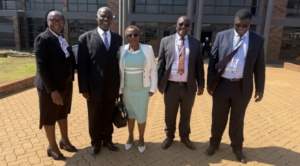
Dr. Gladys Siwela-Jadagu with leaders from Zimbabwe Open University, including Professor Chikowore, Vice Chancellor Professor Paul Gundani, and Pro Vice Chancellor for Research, Innovation and Enterprise Development Professor Tavonga Njaya.
On July 30, Siwela-Jadagu attended the Zimbabwe Open University Research and Innovation Conference at the university’s Hatcliffe Campus. Held under the theme From Ideas to Impact: Advancing Research and Innovation for National Transformation, the conference brought together members of the university community to explore research, innovation, and Zimbabwe’s Education 5.0 model.
While at the conference, Siwela-Jadagu engaged with university leadership, including the Vice Chancellor and Pro-Vice Chancellor, as well as academics and students. She also attended a Business Plan Presentation Contest, providing another opportunity to observe conversations around innovation and entrepreneurship within the university environment.
The conversations continued beyond higher education.
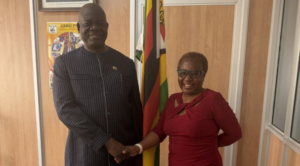
Dr. Gladys Siwela-Jadagu with Zimbabwe’s Minister of Primary and Secondary Education, Hon. Torerayi Moyo.
On August 6, Siwela-Jadagu met with Zimbabwe’s Minister of Primary and Secondary Education, Hon. Torerayi Moyo. Their discussion focused on developments within Zimbabwe’s education system, including the Heritage-Based Curriculum and Education 5.0 framework, as well as the role of artificial intelligence and emerging technologies in education.
Their conversation also explored the opportunities and challenges associated with emerging technologies, the importance of education keeping pace with technological change, and how artificial intelligence can support rather than replace critical thinking and human capability.
For Siwela-Jadagu, those conversations also have relevance for her work with students at Warner Pacific.
“These experiences gave me an opportunity to engage directly with educators, policymakers, and colleagues around many of the same issues shaping our classrooms today, particularly artificial intelligence, innovation, and the future of education,” said Siwela-Jadagu. “Bringing those perspectives back to Warner Pacific enriches my teaching and helps our students think more globally about the opportunities and challenges they will encounter in their own careers.”
Scholarship at the Intersection of AI and Education
The conversations Siwela-Jadagu encountered in Zimbabwe were particularly relevant to her current scholarly work.
Together with Meredith Killgore Villa, Instructional Designer at Warner Pacific, she is contributing a chapter to a forthcoming book to be published by Africa University. Their chapter, Artificial Intelligence and the Future of Teaching in Africa: Pedagogy, Technology Exclusion, and Epistemic Justice, examines the implications of AI for teaching and learning in African higher education.
The work considers issues including pedagogy, critical thinking, technology exclusion, and responsible AI integration. During her time in Zimbabwe, Siwela-Jadagu and Killgore Villa responded to reviewer feedback and continued revising and editing the chapter.
Working on the scholarship while in Zimbabwe created a timely connection between her research and broader conversations taking place around Education 5.0, innovation, technology access, and the future of education.
Building Global Professional Connections
Siwela-Jadagu also used her time in Zimbabwe to reconnect with the Macroeconomic and Financial Management Institute of Eastern and Southern Africa (MEFMI), where she previously worked.
During the visit, she met informally with the director responsible for MEFMI’s Debt Management Program. The organization provides capacity-building programs for officials from its member countries, particularly those working in central banks and ministries of finance. Its Debt Management Program is exploring opportunities for university-based academic certification for participants who complete its professional training program.
Her summer engagements also included meeting with colleagues contributing to a Global Business Management textbook currently in development. Their conversations focused on the direction of the book, individual chapter contributions, and next steps as the collaborators begin identifying and engaging reviewers.
“Dr. Siwela-Jadagu’s international engagement reflects the kind of scholarship and professional experience that strengthens our School of Business,” said Dr. Ulf Spears, Dean of the School of Business. “These connections bring global perspectives into the learning environment and help prepare our students to lead and serve in an increasingly interconnected world.”
Siwela-Jadagu’s summer engagements reflect the connection between faculty scholarship, professional experience, and student learning at Warner Pacific. By remaining engaged in global conversations shaping business, technology, and education, WPU faculty can bring current perspectives and real-world experience into the classroom—helping students understand their fields within an increasingly interconnected world.